
Lynchburg Resident Lookup Sources
A careful resident lookup uses sources that answer different questions. The City Assessor and Parcel Viewer can tie an owner name to a parcel, while a deed identifies the recorded parties and legal description. The voter route can confirm an individual's registration status and polling information, but it is not a complete household roll. Court and probate records can reveal a dated public case or estate relationship. Vital indexes and library sources help place a person in time. No single result proves current occupancy, especially for protected voters, minors, or people who have moved.
| Record | What It Confirms | Where | Access |
|---|---|---|---|
| Assessor/GIS parcel | Owner field, situs address, Parcel_ID, and legal-lot clues | City Assessor, Parcel Viewer, and ArcGIS | Public search; not a complete occupancy record |
| Deed/index | Recorded grantor, grantee, date, book/page, and legal description | Circuit Clerk, SRA, and Library of Virginia | Research room; SRA subscription for images; clerk copies |
| Voter status | Individual registration and polling-place information | Virginia Citizen Portal and Lynchburg Registrar | Limited public fields and protected-address rules |
| Court case | Public party role, case number, filing, and disposition | Circuit/GDC portals and clerk terminal | Portal barriers; sealed, juvenile, and expunged matters restricted |
| Vital index | Event name, date, and place after the public period | VDH, Library of Virginia, and FamilySearch | Births have a 100-year period; other listed events have 25 years |
| Entity or license | Public business affiliation or credential status | SCC CIS, DPOR, and DHP | Free lookup, with some verification services charging separately |
Begin with the source closest to the known fact. A former address points first to the parcel and deed trail. A probate question belongs with the Circuit Clerk. A death or marriage date belongs with the Virginia Department of Health index, then the issuing custodian if a certified copy is needed.
Lynchburg is an independent city, so a city parcel belongs with Lynchburg's own Circuit Clerk, assessor, and GIS offices rather than Campbell County. A boundary address deserves an early jurisdiction check. Campbell County records are held separately in Rustburg, and a postal address alone does not settle which office owns the record.
Verify a Lynchburg Resident
Use a full name, middle initial, approximate date, and Lynchburg street or neighborhood to reduce the same-name problem. Record spelling variants, initials, suffixes, and any spouse notation before joining results. Match independent details, not just a surname and city: Parcel_ID and legal description on a deed, a court party role and case date, a voter district, or an obituary relative can strengthen a match. A clerk can confirm whether a public file exists, but should not be expected to provide private facts by phone.
- Search the assessor or Parcel Viewer by owner name and record the Parcel_ID, situs address, owner field, and any displayed mailing detail.
- Check the recorded deed through the Circuit Clerk index, noting the grantee, grantor, recording date, and legal description.
- Use the Virginia voter portal for individual registration or polling-place status, without treating a nonmatch as proof that someone is absent from Lynchburg.
- Check public Circuit or General District material online when available, then use the clerk terminal or records room when an access barrier blocks the portal.
- Corroborate the time period through vital, probate, obituary, cemetery, license, or entity records as appropriate.
The sample Lynchburg parcel card identifies a Parcel ID, owner, property address, area, legal acreage, GIS acreage, and an informational disclaimer. Those fields describe a parcel record. They do not prove that every person associated with the property lives there.
- Docket
- A court's running case record, usually organized around a case number, parties, dates, and public case events.
- Index versus image
- An index points to a record, while an image is the scanned underlying page. The clerk may be needed for an official copy.
- Certified copy
- A copy issued or certified by the custodian for a record that the office determines may be released.
Keep a verification worksheet with the source date, record type, exact spelling, printed address, person-role label, and next office to check. A notation such as “grantee in 1998 deed” should remain separate from “owner on assessor card” or “directory resident in 1909.” That discipline prevents several weak matches from being presented as one identity.
Lynchburg Court Lookup Fallbacks
Virginia's self-help page directs users to locality-based Circuit and General District case systems. During the research pass, the Circuit link returned a 403 and the General District route required captcha or redirect handling, so exact public form labels were not verified. When that happens, use the Circuit Clerk's public-records room or call the relevant division at 434-455-2620. Ask whether a case is public, archived, sealed, expunged, or held by another division before requesting a copy. Juvenile and Domestic Relations information has stronger privacy limits and is not available through that public online route.
The Lynchburg Police records-request instructions show the separate incident-report request channel.
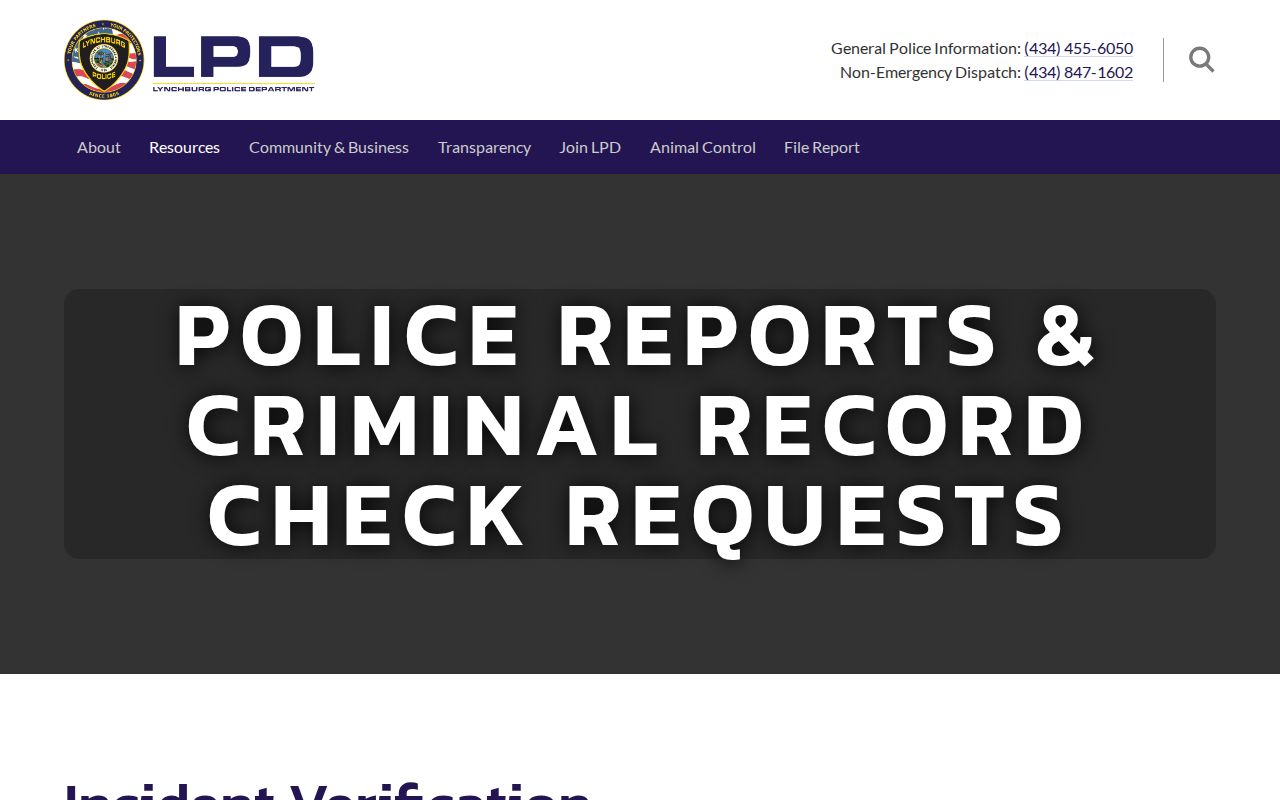
An incident report and a court docket are separate systems. The police route has eligibility and request rules, while a public court case may still need a clerk copy request for filed documents.
Virginia Freedom of Information Act requests are a further channel for existing, non-exempt city records. The city says a reasonably specific request may be made by mail, fax, email, in person, or phone and normally receives a response within five working days. That process cannot open sealed material, juvenile records, protected addresses, or an expunged charge removed from court records.
Lynchburg Vital Record Windows
Virginia Code §32.1-271 makes birth records public after 100 years and death, marriage, and divorce records public after 25 years. The Virginia Department of Health genealogy route lists statewide index coverage, while the Library of Virginia offers historical microfilm alternatives. A public index entry is not the same thing as eligibility for a restricted-year certified copy. Modern requests require the proper written request, identification, and fee through VDH's online, mail, or in-person channels. The Lynchburg Health Department provides local registrar service, but confirm whether a particular certificate can be issued locally before visiting.
The VDH vital-record application begins with certificate-type choices rather than an open people search.
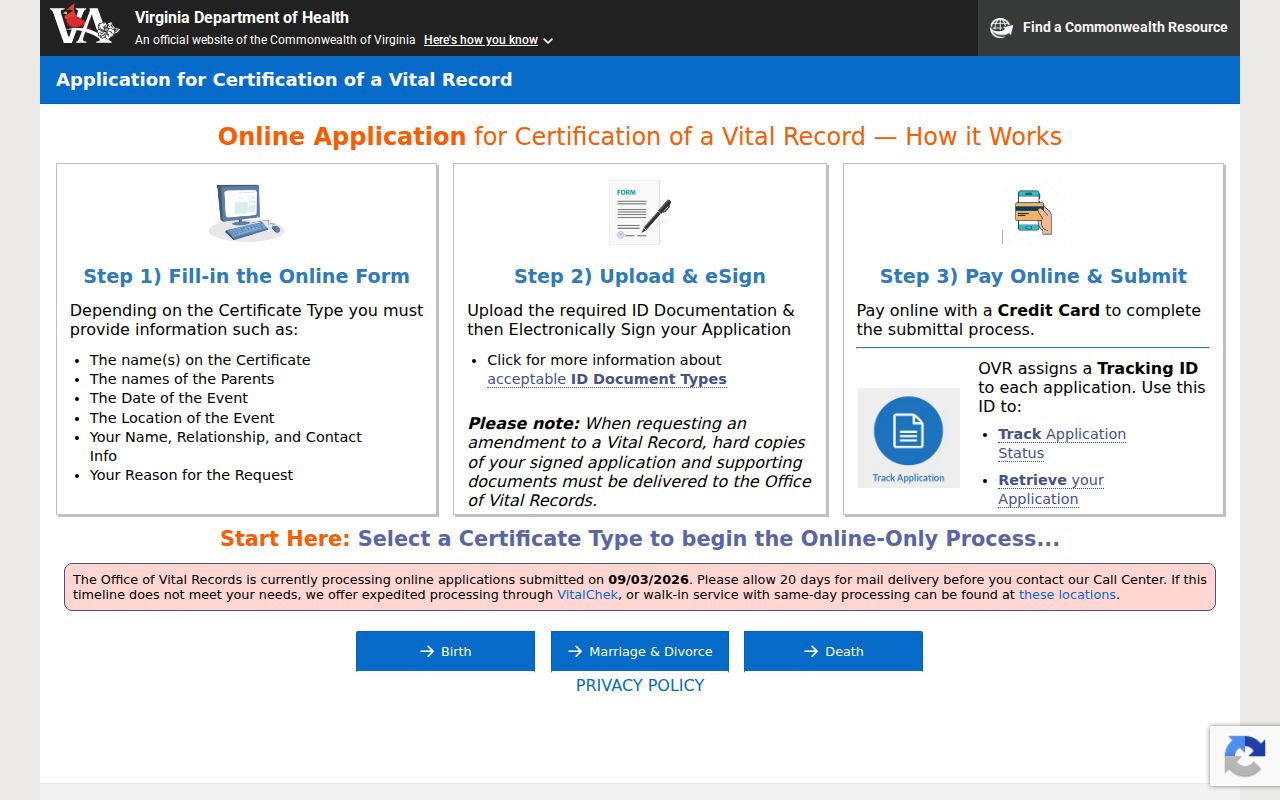
Use a full name, event date, and locality written as Lynchburg city when making a records request. A postal Lynchburg address does not make a Campbell County event a Lynchburg-city record.
VDH lists birth and death indexes from 1912, marriage indexes from 1936, and divorce indexes from 1918. Surviving older Virginia copies follow different Library of Virginia archive routes. The listed VDH search or copy fee is $15 even if a search finds no record, so narrow the request with the event place and date before submitting it.
Lynchburg Adoption Disclosure Route
Birth-family research follows a different path from an ordinary resident lookup. The Virginia DSS Adoption Disclosure program is the official route for eligible adult adoptees, adoptive parents, birth parents, and adult birth siblings. The agency's search and permission process governs identifying information, and the Virginia Birth Father Registry is confidential. A former classmate or historical relative may instead be better served by Jones Memorial Library yearbooks, newspapers, and archives. The Lynchburg city directory collections can help establish an older address or spelling before an official request is made.
No unrestricted official alumni directory was located for Lynchburg's colleges. Library staff and institutional archives are the documented alternatives for historical yearbooks and related material. Do not treat an older school, directory, or obituary reference as proof that someone still lives in Lynchburg.
Lynchburg Entity and License Checks
Business and professional sources can confirm a public affiliation, not a private residence. The Virginia SCC Clerk's Information System supports entity-name or entity-ID research and can return an entity ID, name, type, address, formation date, and status. A registered office or agent is an entity record, so keep it separate from a person's current address. Lynchburg has no public city business-license name database documented in the research; the Commissioner of Revenue and local filing routes remain the fallback for an existing local record.
The SCC CIS entity search is the source captured here.
Entity results can establish a dated filing relationship, then the underlying filing or the named state office can answer a narrower question.
The Virginia DPOR License Lookup accepts a general search and offers advanced routes for a name, license number, address, or license type.
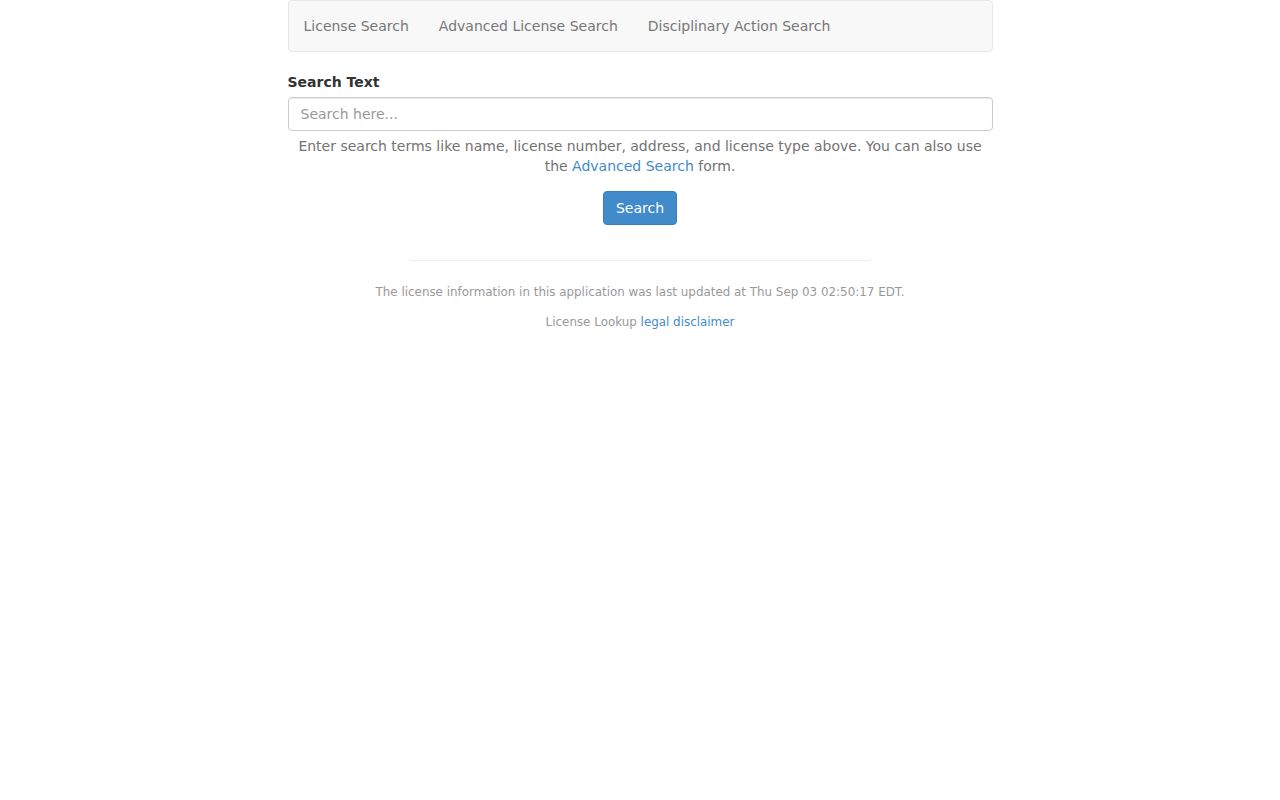
DPOR displays license status and updates with a disclaimer, but the public result is not an official certification. DHP has a separate practitioner verification route.
Lynchburg Voter Lookup Limits
The Virginia Citizen Portal is for individual registration, polling-place, absentee, and voting-history functions. It is not an all-neighbors export. Under Va. Code §24.2-444, public voter lists have limited fields, while Social Security numbers, full dates of birth, protected addresses, and other registration materials are closed. Protected-voter provisions can substitute a designated mailing address or omit the residence address. For a lawful list request, use the Department of Elections form and its client-type, use, and locality requirements instead of assuming the online portal supplies a downloadable list.
Note: Registration at a listed address is dated evidence, not proof that a person presently occupies a property.
Lynchburg Resident Lookup Boundaries
Virginia's Address Confidentiality Program protects eligible participants' actual addresses, and city exemptions protect utility accounts, library records, social-services information, complaint-maker contacts, and individual tax returns. The Driver's Privacy Protection Act also restricts personal information from motor-vehicle records. When an official record appears wrong, identify the custodian and record number, ask about that office's correction process, submit supporting proof, and keep the response. A VFOIA request can seek existing non-exempt records, but it does not require an office to create information or rewrite an accurate historical record.
Lawful use. Use Lynchburg resident lookup results for personal, lawful research and verify material facts with the custodian. Repeated contact, surveillance, intimidation, or harassment can violate Virginia law.